Interview U Chit San Win (1940-2025)
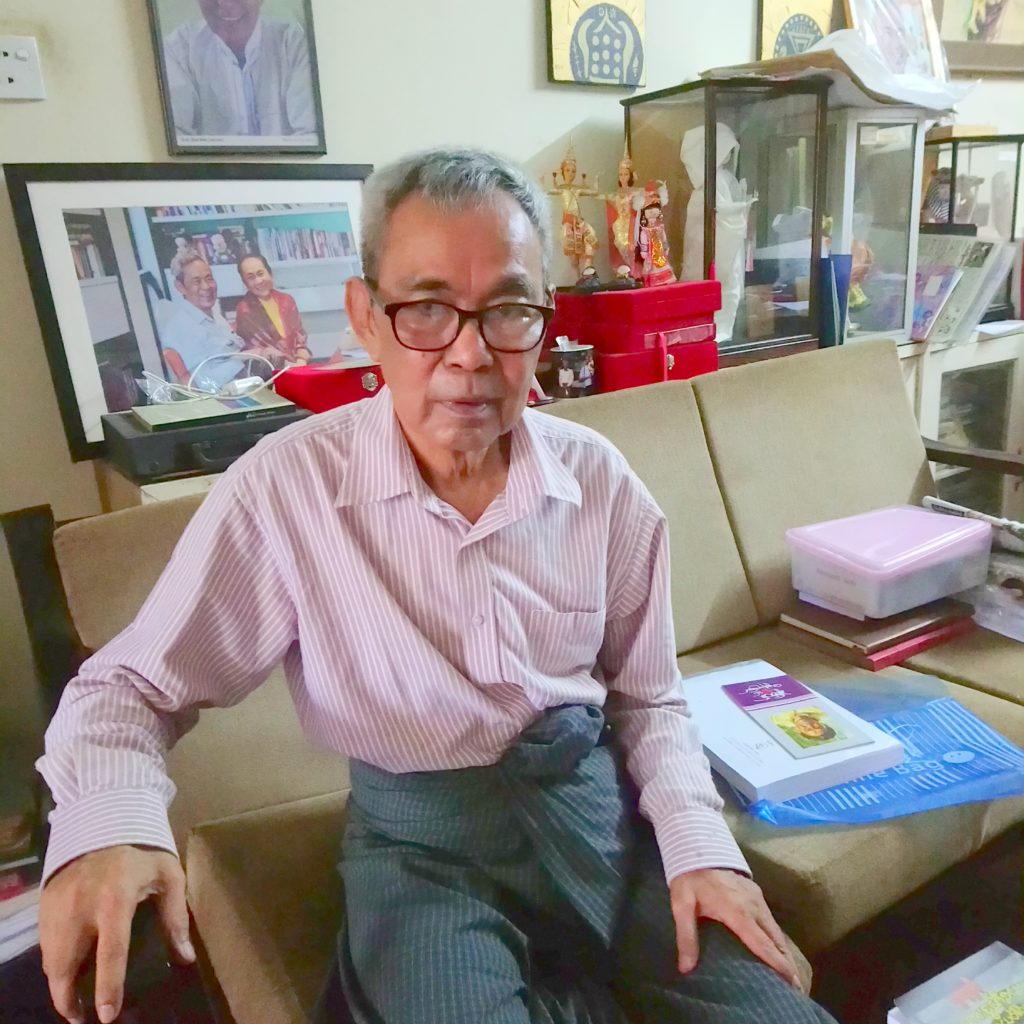
My name is U Chit San Win. I was born in 1940 in Yitkangyi Village, Kawa, Bago Division, to Daw Thinn Htone and her husband (an only child). My biological father died shortly after my birth (1941). Ten years after his death, my mother married my stepfather, U Kyaw Sein. I am married and had four sons with my wife, Nelly. One of them sadly died at a young age. I am a Buddhist and a Burmese citizen. I have been a writer for a long time and a publisher since 1977.
After my father’s death, my mother moved into my grandfather’s house. At Sasana Jotika Pubbarama Monastery, I was a student of U Wiriya. My stepfather was always very good to me. He paid for my private school (Hsayagyi U Tha Din’s Special Grammar School) in Bago. Even then, private schools were considered superior to public schools. I then went to Yankin College, where I graduated in 1957. I enrolled at Yangon University to study biology, laying the foundation for medical school. The language of instruction there was English, which I didn’t understand very well. To this day, I still don’t speak it as well as I would have liked. So I changed my major and began studying Burmese literature and East-West history. I earned my bachelor’s degree in 1967. I then worked for the State Timber Board and the Bamar Departmental Store. From 1965 to 1967, I was an assistant teacher at an elementary school in Thaketa (8th district).
I was always interested in politics. I had very positive memories of the Caretaker government from 1958 to 1960. In 1962, Ne Win’s military coup took place, and the BSPP (Burmese Socialist Way Party) was founded. I joined it in 1964. I then transferred from school to the party’s education department. Later, I worked on the editorial board of a BSPP party magazine (Lanzin News Journal), which was published biweekly. I started there as a reporter and later became editor. Lanzin News Journal was just one of many party publications. It covered a wide range of topics, and its readers were predominantly party members. In 1988, the magazine was shut down, and I lost my job. I believed in socialism, but I think the military had betrayed its ideals. In my opinion, the upheaval of 1988 was positive for the country.
I founded my own publishing company (Hundred Flowers) back in 1977. I mainly publish my own books. I have written 162 so far (including many translations of English authors, e.g., Zig Ziglar). Many of my works deal with travel (Travelogues, in Burmese, e.g., about Angkor Wat). I took my first steps in this direction when I went to Bangkok in 1988 and wrote essays about the city (Bangkok 1, 2, 3, also in Burmese). My books usually have print runs of between 2,000 and 5,000 copies. I also published articles for magazines such as The Guardian Magazine. My wife speaks better English than I do and helps me with translations. I have edited various magazines, including Peasant’s Journal and Kyee Pwa Yay. I am also active in other fields. In 1988, I met three Japanese men in Bangkok with whom I started a business. We exported pickles.
I have been involved in the rehabilitation of leprosy patients and in the government’s polio vaccination campaigns, as well as in the Ledi Sayadaw institution. I have also been active in promoting Burmese puppet theater (in this field, I met Chit San Win, and I owe him many suggestions for my dissertation, Axel Bruns’ note). I am particularly interested in the Dhammazedi bell. This bell was the heaviest in the world (weighing approximately 300 tons) and was stolen from the Shwedagon Pagoda in 1608 by Felipe de Brito. He planned to melt it down to make cannons. En route to his royal residence, Syriam (Thanlyin), the ship carrying its valuable cargo sank near Monkey Point in the Yangon/Hlaing River. Since then, countless people have tried to find it, so far without success!